Cross-Platform Performance Prediction of Software Applications Using Machine Learning Models for Optimized Resource Utilization
DOI:
https://doi.org/10.26629/jtr.2025.83Keywords:
Cross-Platform Performance Prediction, Energy-Efficient Computing, Meta-Learning, Resource Utilization Optimization, Software Performance Modelling.Abstract
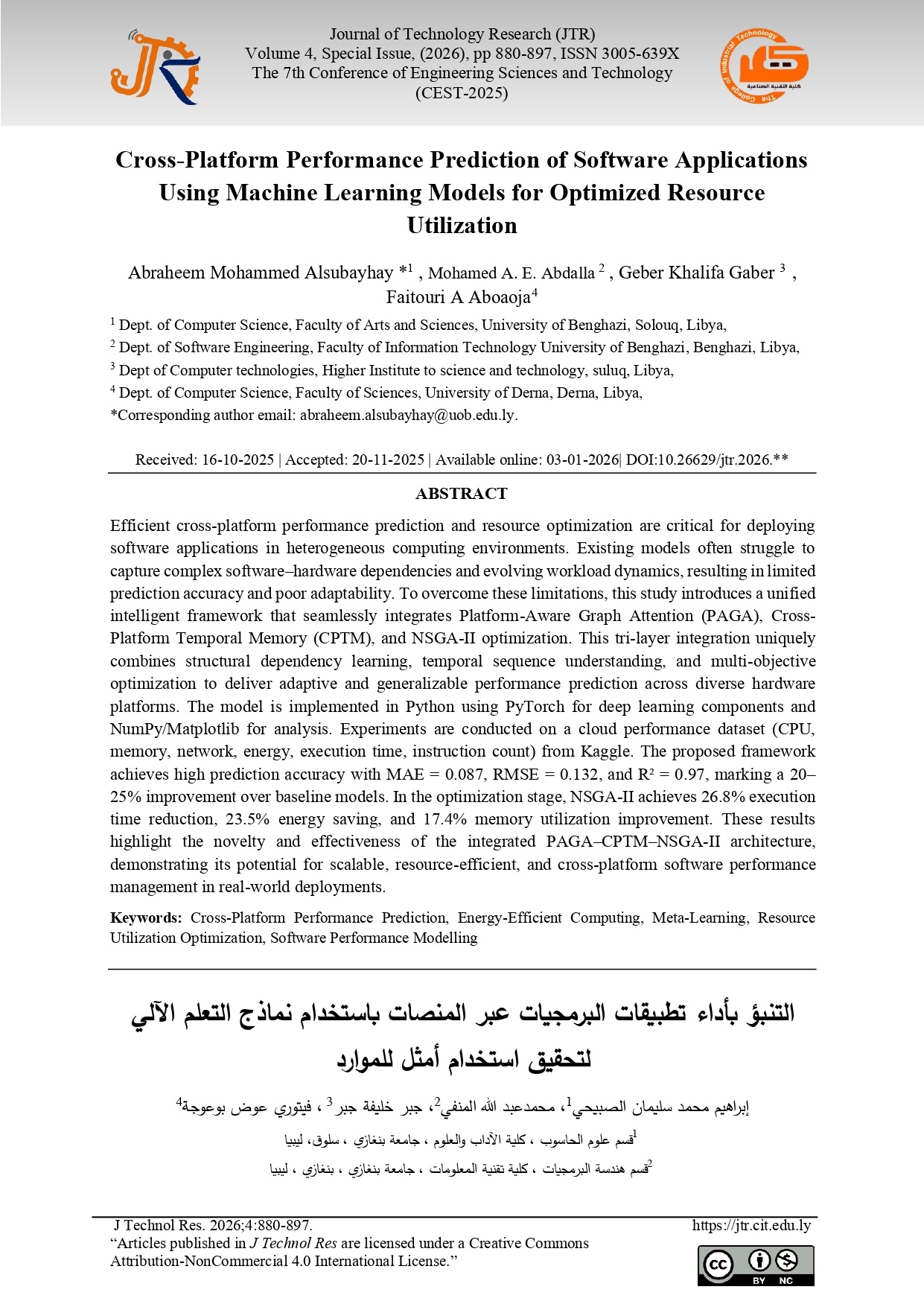
Efficient cross-platform performance prediction and resource optimization are critical for deploying software applications in heterogeneous computing environments. Existing models often struggle to capture complex software–hardware dependencies and evolving workload dynamics, resulting in limited prediction accuracy and poor adaptability. To overcome these limitations, this study introduces a unified intelligent framework that seamlessly integrates Platform-Aware Graph Attention (PAGA), CrossPlatform Temporal Memory (CPTM), and NSGA-II optimization. This tri-layer integration uniquely combines structural dependency learning, temporal sequence understanding, and multi-objective optimization to deliver adaptive and generalizable performance prediction across diverse hardware platforms. The model is implemented in Python using PyTorch for deep learning components and NumPy/Matplotlib for analysis. Experiments are conducted on a cloud performance dataset (CPU, memory, network, energy, execution time, instruction count) from Kaggle. The proposed framework achieves high prediction accuracy with MAE = 0.087, RMSE = 0.132, and R² = 0.97, marking a 20– 25% improvement over baseline models. In the optimization stage, NSGA-II achieves 26.8% execution time reduction, 23.5% energy saving, and 17.4% memory utilization improvement. These results highlight the novelty and effectiveness of the integrated PAGA–CPTM–NSGA-II architecture, demonstrating its potential for scalable, resource-efficient, and cross-platform software performance management in real-world deployments
Downloads
Downloads
Published
Issue
Section
License
Copyright (c) 2026 Journal of Technology Research

This work is licensed under a Creative Commons Attribution-NonCommercial 4.0 International License.











 Articles licensed under a