Evaluation of Some Holy Quran Recitation Rules Using Long Short-Term Memory (LSTM) Networks
DOI:
https://doi.org/10.26629/jtr.2025.15Keywords:
Quran Recitation, Tajweed, LSTM Networks, Mel-Frequency Cepstral Coefficients (MFCC), Artificial IntelligenceAbstract
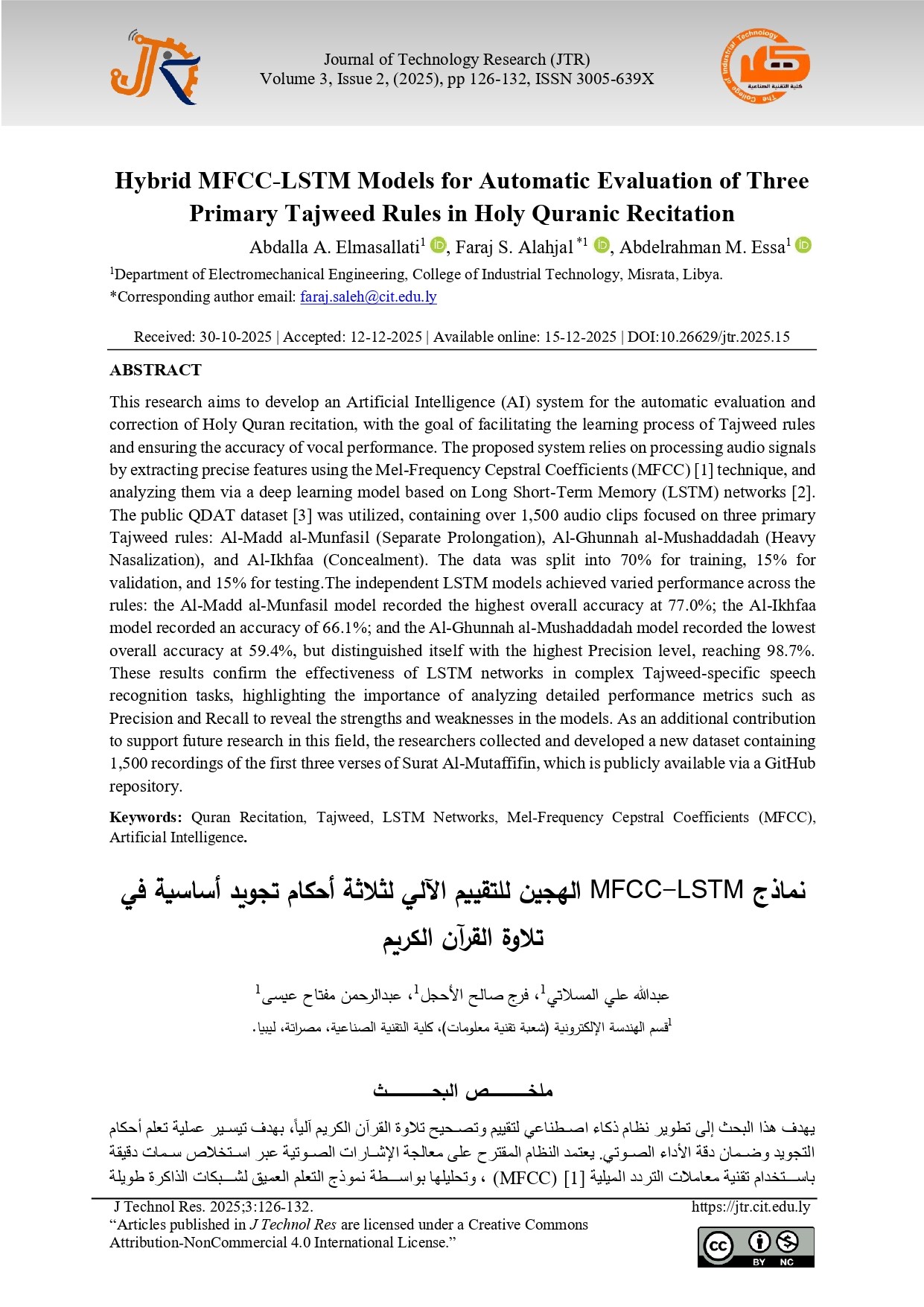
This research aims to develop an Artificial Intelligence (AI) system for the automatic evaluation and correction of Holy Quran recitation, with the goal of facilitating the learning process of Tajweed rules and ensuring the accuracy of vocal performance. The proposed system relies on processing audio signals by extracting precise features using the Mel-Frequency Cepstral Coefficients (MFCC) [1] technique, and analyzing them via a deep learning model based on Long Short-Term Memory (LSTM) networks [2]. The public QDAT dataset [3] was utilized, containing over 1,500 audio clips focused on three primary Tajweed rules: Al-Madd al-Munfasil (Separate Prolongation), Al-Ghunnah al-Mushaddadah (Heavy Nasalization), and Al-Ikhfaa (Concealment). The data was split into 70% for training, 15% for validation, and 15% for testing.
The independent LSTM models achieved varied performance across the rules: the Al-Madd al-Munfasil model recorded the highest overall accuracy at 77.0%; the Al-Ikhfaa model recorded an accuracy of 66.1%; and the Al-Ghunnah al-Mushaddadah model recorded the lowest overall accuracy at 59.4%, but distinguished itself with the highest Precision level, reaching 98.7%.
These results confirm the effectiveness of LSTM networks in complex Tajweed-specific speech recognition tasks, highlighting the importance of analyzing detailed performance metrics such as Precision and Recall to reveal the strengths and weaknesses in the models. As an additional contribution to support future research in this field, the researchers collected and developed a new dataset containing 1,500 recordings of the first three verses of Surat Al-Mutaffifin, which is publicly available via a GitHub repository.
Downloads
Downloads
Published
Issue
Section
License
Copyright (c) 2025 Journal of Technology Research

This work is licensed under a Creative Commons Attribution-NonCommercial 4.0 International License.














 Articles licensed under a