Comprehensive Impact Assessment of Dust Emissions from Benghazi Cement Plant: Health Burden, Environmental Degradation, and Mitigation Efficacy
DOI:
https://doi.org/10.26629/jtr.2025.32Keywords:
Cement pollution, Particulate Matter, PM2.5, PM10, Occupational Exposure, BenghaziAbstract
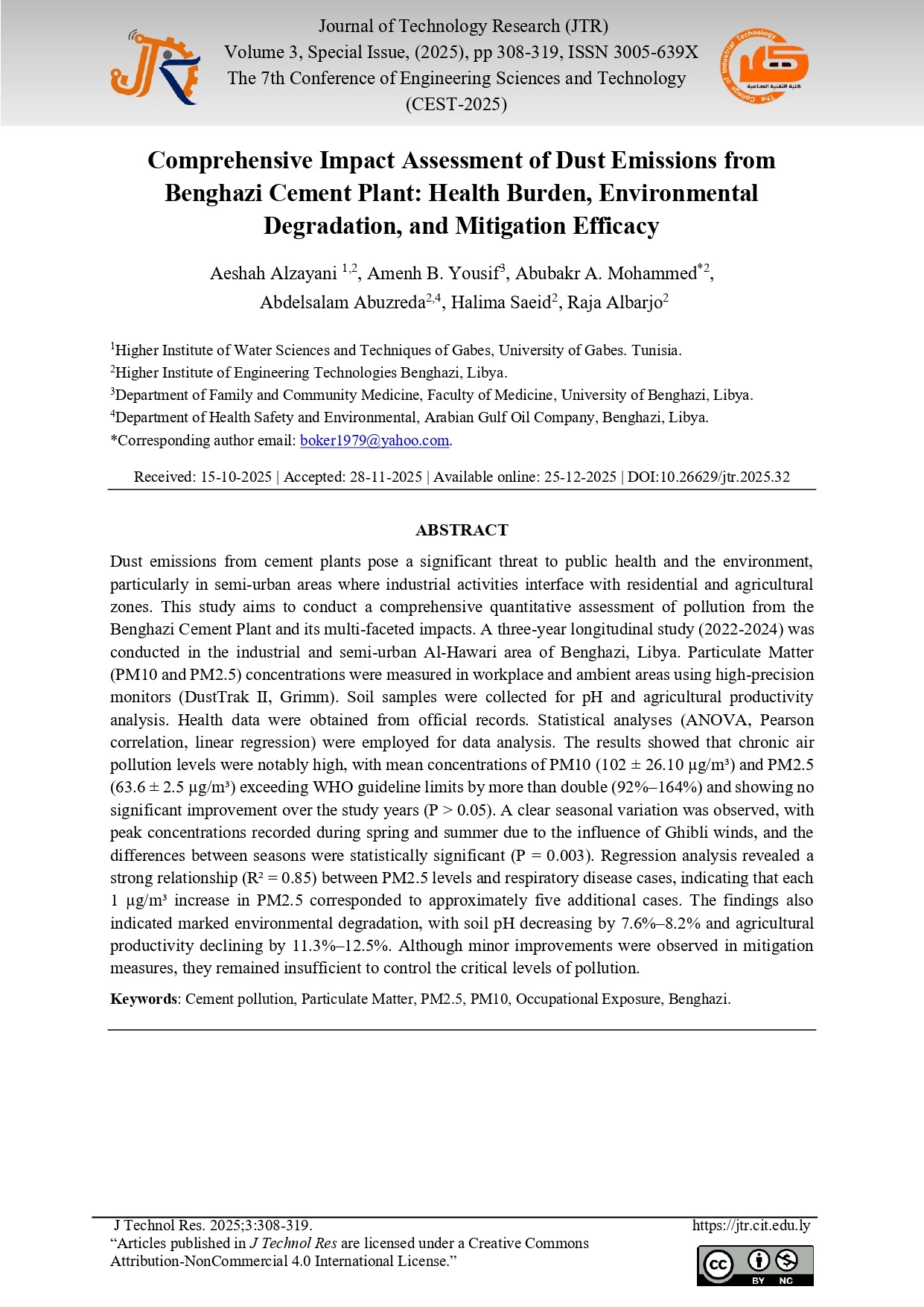
Dust emissions from cement plants pose a significant threat to public health and the environment, particularly in semi-urban areas where industrial activities interface with residential and agricultural zones. This study aims to conduct a comprehensive quantitative assessment of pollution from the Benghazi Cement Plant and its multi-faceted impacts. A three-year longitudinal study (2022-2024) was conducted in the industrial and semi-urban Al-Hawari area of Benghazi, Libya. Particulate Matter (PM10 and PM2.5) concentrations were measured in workplace and ambient areas using high-precision monitors (DustTrak II, Grimm). Soil samples were collected for pH and agricultural productivity analysis. Health data were obtained from official records. Statistical analyses (ANOVA, Pearson correlation, linear regression) were employed for data analysis. The results showed that chronic air pollution levels were notably high, with mean concentrations of PM10 (102 ± 26.10 µg/m³) and PM2.5 (63.6 ± 2.5 µg/m³) exceeding WHO guideline limits by more than double (92%–164%) and showing no significant improvement over the study years (P > 0.05). A clear seasonal variation was observed, with peak concentrations recorded during spring and summer due to the influence of Ghibli winds, and the differences between seasons were statistically significant (P = 0.003). Regression analysis revealed a strong relationship (R² = 0.85) between PM2.5 levels and respiratory disease cases, indicating that each 1 µg/m³ increase in PM2.5 corresponded to approximately five additional cases. The findings also indicated marked environmental degradation, with soil pH decreasing by 7.6%–8.2% and agricultural productivity declining by 11.3%–12.5%. Although minor improvements were observed in mitigation measures, they remained insufficient to control the critical levels of pollution.
Downloads
Downloads
Published
Issue
Section
License
Copyright (c) 2025 Journal of Technology Research

This work is licensed under a Creative Commons Attribution-NonCommercial 4.0 International License.













 Articles licensed under a