
Enhancing Liver PET Image Quality and Tumor Delineation Using CLAHE: A Quantitative Evaluation on Y-90 Dataset
DOI:
https://doi.org/10.26629/jtr.2025.67Keywords:
CLAHE, Liver, Tumor Localization, PET, CTAbstract
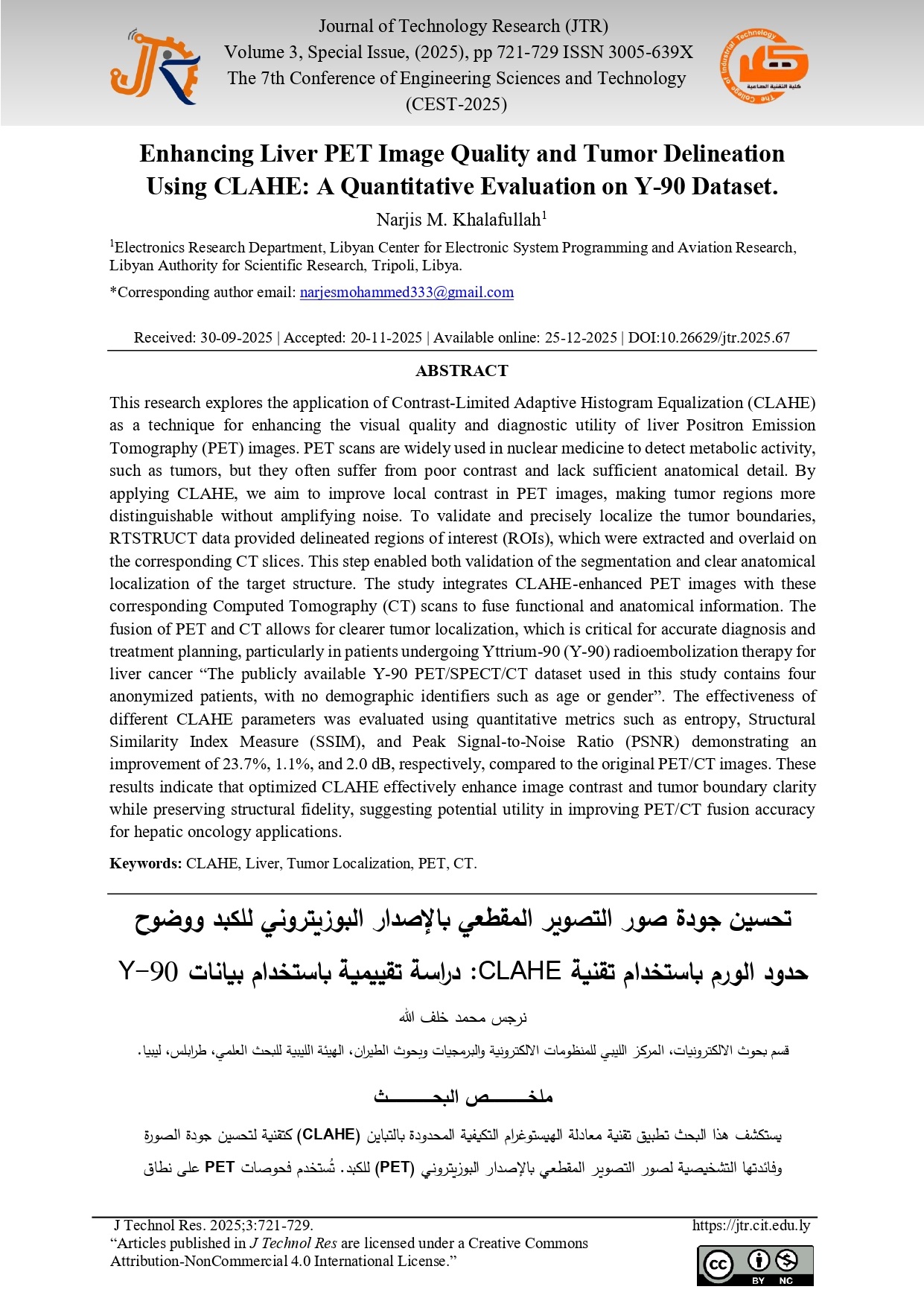
This research explores the application of Contrast-Limited Adaptive Histogram Equalization (CLAHE) as a technique for enhancing the visual quality and diagnostic utility of liver Positron Emission Tomography (PET) images. PET scans are widely used in nuclear medicine to detect metabolic activity, such as tumors, but they often suffer from poor contrast and lack sufficient anatomical detail. By applying CLAHE, we aim to improve local contrast in PET images, making tumor regions more distinguishable without amplifying noise. To validate and precisely localize the tumor boundaries, RTSTRUCT data provided delineated regions of interest (ROIs), which were extracted and overlaid on the corresponding CT slices. This step enabled both validation of the segmentation and clear anatomical localization of the target structure. The study integrates CLAHE-enhanced PET images with these corresponding Computed Tomography (CT) scans to fuse functional and anatomical information. The fusion of PET and CT allows for clearer tumor localization, which is critical for accurate diagnosis and treatment planning, particularly in patients undergoing Yttrium-90 (Y-90) radioembolization therapy for liver cancer “The publicly available Y-90 PET/SPECT/CT dataset used in this study contains four anonymized patients, with no demographic identifiers such as age or gender”. The effectiveness of different CLAHE parameters was evaluated using quantitative metrics such as entropy, Structural Similarity Index Measure (SSIM), and Peak Signal-to-Noise Ratio (PSNR) demonstrating an improvement of 23.7%, 1.1%, and 2.0 dB, respectively, compared to the original PET/CT images. These results indicate that optimized CLAHE effectively enhance image contrast and tumor boundary clarity while preserving structural fidelity, suggesting potential utility in improving PET/CT fusion accuracy for hepatic oncology applications.
Downloads
Downloads
Published
Issue
Section
License
Copyright (c) 2025 Journal of Technology Research

This work is licensed under a Creative Commons Attribution-NonCommercial 4.0 International License.











 Articles licensed under a